

Titanium Pipe Fittings Processing: Precautions & Characteristic Analysis When The Hydrogen Content Is Too High
Titanium Pipe Fittings Processing: Precautions & Characteristic Analysis When The Hydrogen Content Is Too High
In the processing process of titanium pipe
fittings, the hydrogen content is a key factor that needs to be strictly
controlled. When the hydrogen content in titanium pipe fittings is too high, it
will have a significant adverse impact on its performance, which in turn
affects the entire processing process and the quality of the final product.
Hazards & Standards Of Excessive Hydrogen Content
When the hydrogen content in titanium pipe
fittings exceeds a reasonable range, its impact toughness and notch tensile
strength will decrease due to increased brittleness. This is because the
presence of hydrogen atoms in the titanium lattice will interfere with the
binding force between the titanium atoms, resulting in a decrease in the
toughness of the material, and it is more prone to brittle fracture when
subjected to external forces. In order to ensure the performance and quality of
titanium pipe fittings, it is generally stipulated that the hydrogen content in
titanium pipe fittings should not be higher than 0.015%.This standard has been
verified by a large number of experiments and practices, and is an important
basis for ensuring the safe and reliable operation of titanium pipe fittings
under various working conditions.
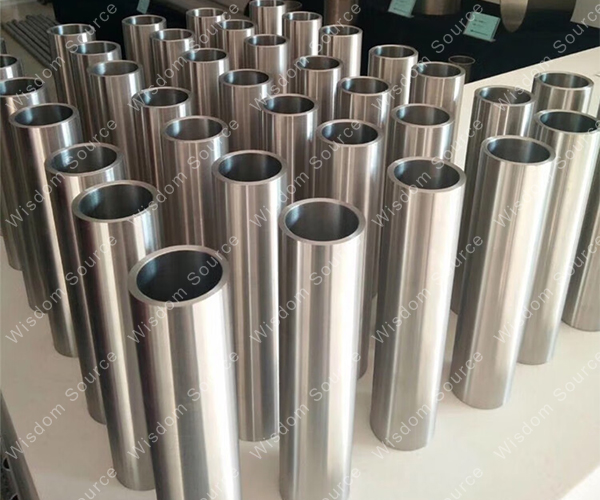
Measures To Reduce Hydrogen Absorption
1. Cleaning work before heat treatment
In order to reduce the absorption of
hydrogen by titanium pipe fittings during processing, cleaning before heat
treatment is essential. Fingerprints, wear marks, grease, and other residues
may contain hydrogen or provide conditions for the absorption of hydrogen. Therefore,
before heat treatment, the titanium pipe fittings must be thoroughly cleaned to
remove impurities such as fingerprints, wear marks, grease, etc. on the
surface. Organic solvent cleaning, ultrasonic cleaning and other methods can be
used to ensure that the surface of the titanium pipe fittings is clean and
pollution-free.
2. Ensure the environment in the heat
treatment furnace
The environment in the heat treatment
furnace also has a great impact on the hydrogen content of titanium pipe
fittings. Water vapor is one of the important sources of hydrogen. If there is
water vapor in the heat treatment furnace, the titanium pipe fittings will
absorb hydrogen during the heating process, resulting in an increase in
hydrogen content. Therefore, before heat treatment, make sure that the
anhydrous vapor in the heat treatment furnace is dry. The moisture and air in
the furnace can be eliminated by preheating the furnace and introducing dry
inert gas, so as to create a good environment for the heat treatment of
titanium pipe fittings.
3. Treatment method for excessive hydrogen
content
When the hydrogen content of titanium pipe
fittings is higher than the allowable value, the method of vacuum annealing
needs to be used for cleaning. Vacuum annealing is the heating treatment of
titanium pipe fittings in a vacuum environment to cause hydrogen to escape from
the titanium pipe fittings. In a vacuum environment, the partial pressure of
hydrogen is extremely low, which is conducive to the diffusion and discharge of
hydrogen. At the same time, the appropriate heating temperature can promote the
mobility of hydrogen atoms and accelerate the escape process of hydrogen. The
temperature and time of vacuum annealing need to be determined according to the
specific conditions and hydrogen content of titanium pipe fittings. It
generally needs to be maintained at a higher temperature for a certain period
of time to ensure that the hydrogen can be fully discharged.
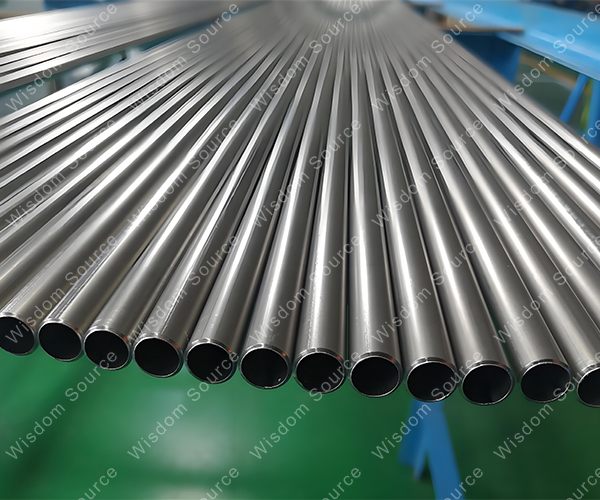
Oxidation & Deoxygenation Problems During Heat Treatment
1. Generation of oxidation problems
During the heat treatment process, titanium
pipe fittings are prone to oxidation. When the temperature is not higher than
540 degrees, the oxide film of the titanium pipe fittings will not thicken
much, and the impact on the material properties is relatively small. However,
at higher heat treatment temperatures, the oxidation rate will be accelerated,
and the inner diffusion layer of the oxidized material will become a layer of
pollution. The oxygen-contaminated layer has a high brittleness ratio, which
can cause cracks and damage to the surface of the parts, which seriously
affects the quality and service life of titanium pipe fittings.
2. Method of deoxygenating the contaminated
layer
In order to remove the oxygen pollution
layer, machining, pickling, chemical grinding and other methods can be used. Machining
is to remove the oxygen-contaminated layer on the surface by cutting, grinding,
etc. This method is suitable for situations where the oxygen-contaminated layer
is thicker. Pickling is the use of an acid solution to react chemically with
the oxygen contaminated layer to dissolve and remove it. Commonly used acid
solutions include hydrofluoric acid, nitric acid, etc., But during the pickling
process, care should be taken to control the concentration, temperature and
time of the acid solution to avoid excessive corrosion of titanium pipe fittings.
Chemical grinding is the use of chemicals to react chemically with the surface
of titanium pipe fittings, and at the same time cooperate with mechanical
friction to remove the oxygen pollution layer and make the surface smoother and
smoother.
3. Measures to reduce oxidation
During heat treatment, in order to reduce
the impact of oxidation on titanium pipe fittings, the heating time should be
shortened as much as possible under the premise of ensuring the heat treatment
effect. Too long heating time will increase the time for titanium pipe fittings
to come into contact with oxygen, thereby increasing the degree of oxidation. In
addition, the heat treatment can be carried out in a vacuum furnace or an inert
gas furnace. There is almost no oxygen in the vacuum furnace, which can
effectively avoid the oxidation of titanium pipe fittings; the introduction of
inert gases such as argon into the inert gas furnace can isolate the air and
reduce the occurrence of oxidation. The heating of titanium pipe fittings in
the air furnace should be avoided as much as possible. If it must be heated in
the air furnace, appropriate protective measures should be taken, such as the
use of protective coatings, etc., to reduce the oxidative pollution of titanium
pipe fittings by the air.
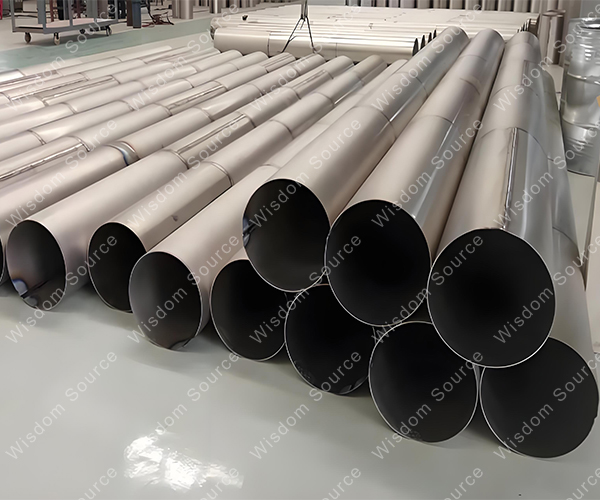
Characteristics Of Titanium Pipe Fittings
1. Corrosion Resistance
Titanium is a highly active metal with a
low equilibrium potential and a strong tendency to thermodynamic corrosion in
the medium. However, titanium has good stability in various media such as
oxidation, neutral, and weak reduction, and exhibits excellent corrosion
resistance. This is because titanium will quickly form a dense oxide film in
the air or in an oxygen-containing medium. This oxide film can prevent oxygen
and other corrosive media from further contacting the titanium matrix, thereby
playing a protective role.
2. Heat Resistance
Titanium pipe fittings have good heat
resistance, and it can be used for a long time at a temperature of 600 degrees
or higher. In a high temperature environment, titanium pipe fittings can still
maintain good mechanical properties and chemical stability, without significant
creep and relaxation, and can meet the requirements of use under high
temperature conditions.
3. Non-Magnetic And Non-toxic
Titanium alloy pipe fittings are a kind of
non-magnetic metal that will not be magnetized in a large magnetic field. This
characteristic makes it widely used in some fields with special requirements
for magnetism, such as electronics, medical and other industries. At the same
time, titanium alloy pipe fittings are non-toxic and will not have harmful
effects on the human body. They can be used in the manufacture of medical
devices and food processing equipment in direct contact with the human body.
4. Low Elastic Modulus
The elastic modulus of titanium pipe
fittings is low, about 57% of that of steel. The lower elastic modulus makes
titanium pipe fittings more prone to elastic deformation when subjected to
force, and has good flexibility and shock absorption properties. In some
occasions with high requirements for shock absorption and flexibility, such as
aerospace, automobile manufacturing and other fields, this characteristic of
titanium pipe fittings has important application value.
5. Inhalation Performance
Titanium pipe fittings are a kind of active
metal that can react with a variety of elements and compounds at high
temperatures. This inhalation performance makes titanium pipe fittings need to
pay attention to contact with other substances during processing to avoid
unnecessary chemical reactions. At the same time, this characteristic can also
be used to improve the performance of titanium pipe fittings through alloying
and other methods to meet different needs.
In the processing process of titanium pipe fittings, great attention should be paid to the issue of hydrogen content, and effective measures should be taken to reduce the absorption of hydrogen and deal with situations where the hydrogen content exceeds the standard. At the same time, it is necessary to fully understand the characteristics of titanium pipe fittings, and reasonably select the processing technology and use environment according to their characteristics to ensure the quality and performance of titanium pipe fittings and promote the wide application of titanium pipe fittings in various fields.