

Tempered With A Thousand Hammers: The Way To Form Titanium Alloy Forgings
Tempered With A Thousand Hammers: The Way To Form Titanium Alloy Forgings
In the eyes of ordinary people, titanium is
a lightweight and sturdy metal, but in the eyes of professionals, there are
subtle differences between titanium and titanium alloys. Among them, Gr5/TC4
(Ti-6Al-4V) is the most representative titanium alloy grade, which is widely
used in aviation, medical, chemical and other fields. To manufacture a
qualified titanium product, forging is an indispensable key link.
The forging of titanium alloy is far from “iron” in the traditional sense. It is a
science that optimizes the internal organizational structure of materials and
improves mechanical properties by precisely controlling temperature and
pressure. For Gr5/TC4 alloy, its phase transition point is between 980℃ and 1010℃, and the α phase and β phase coexist, making it
achieve a good balance between strength and plasticity. And obtaining the ideal
isometric organization is the core of achieving this balance.
The three magic weapons of forging are the basis for ensuring the quality of titanium alloy.
1. The first is temperature control.
Titanium alloys are extremely sensitive to temperature, and high-temperature furnaces and low-temperature furnaces must be used for precise temperature control before forging. In the range of 900℃ to 950℃, titanium alloy exhibits the best processing properties-it not only maintains sufficient strength, but also has good plasticity and is easy to shape.
2. The second is the large-tonnage forging machine.
The hydraulic forging machine can provide huge and stable pressure, so that the metal is evenly deformed during the forging process, and ensure the density and consistency of the internal organization.
3. The third is a professional forging team.
An
efficient operation team is usually composed of more than eight people.
Long-term run-in and tacit cooperation between the members are required to
ensure that each process is accurate and correct.
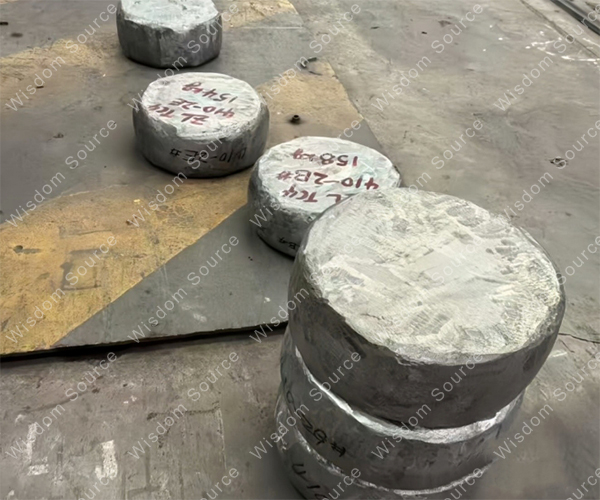
The Forging Process Is Usually Divided Into Three Stages.
1. The First Stage Is To Preheat The Cutting:
After
cutting the titanium alloy blank to a suitable size, put it in a preheating
furnace and slowly heat up to the forging temperature (about 1150℃). This process must strictly control the heating rate to avoid the
internal stress concentration of the material due to excessive temperature
difference.
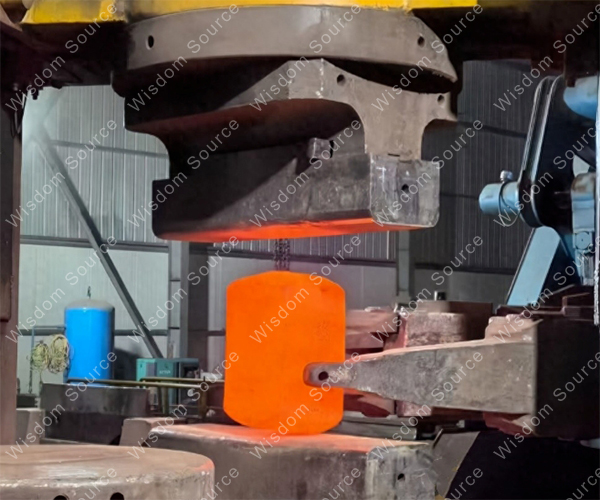
2. The Second Stage Is Forging:
For
preliminary shaping on the press, the process of “three
piers and three shafts” is usually used, and the
roughening and lengthening are repeated to break the remaining coarse grains in
the ingot to make the tissue more uniform. According to the performance
requirements of different products, process routes such as one-fire, two-fire
or three-fire forging can be selected.
3. The Third Stage Is Heat Treatment:
Through
thermal insulation and slow cooling at a specific temperature, the residual
stress generated in the forging process is eliminated and the mechanical
properties of the material are stabilized. Different types of products
correspond to different heat treatment systems, which need to be precisely
formulated according to actual use conditions.
Titanium alloy forgings after forging must
meet strict quality requirements. The surface should be smooth and free of
cracks, folds and other defects; the size must conform to the design drawings;
at the same time, it is necessary to pass advanced non-destructive testing
methods such as ultrasonic testing to ensure that every product meets customer
standards.
Titanium and titanium alloy forging is a precise synergy of material, heat energy and force. It is through the strict control of various process parameters that titanium alloy can be reborn in the “thousand hammers and hundreds of smelting” and become a reliable material for high-end manufacturing and daily life.