

Analysis Of The Whole Process Of Precision Manufacturing Process Of Titanium Bolts
Analysis Of The Whole Process Of Precision Manufacturing Process Of Titanium Bolts
With its excellent properties such as light
weight, high strength and corrosion resistance, titanium bolts have become
indispensable connectors in the fields of aerospace, marine engineering,
medical implants and high-end equipment. However, from a titanium ingot to a
qualified titanium fastener, it needs to go through a number of precise and
rigorous manufacturing processes, each of which directly affects the final
performance and service reliability of the product.
1. Selection Of Raw Materials: The Basic Guarantee Of High-Quality Titanium Ingots
It all starts with the vacuum
self-consuming arc smelting (VAR) process. In order to ensure uniform
composition and extremely low impurity content, titanium ingots usually need to
be smelted three times. According to the target use, choose different grades:
1) TA2 (industrial pure titanium):
excellent corrosion resistance, suitable for chemical, medical and other fields;
2) TC4 (Ti-6Al-4V): α+β type duplex alloy, with high specific
strength, accounting for more than 95% of the amount of aerospace fasteners.
2. Wire Processing: Collaborative Optimization Of Drawing and Annealing
The titanium rod is processed to the target
diameter through multiple cold drawing or hot rolling. This process not only
realizes precise dimensional control, but also optimizes the strength and
plasticity matching of the material. For ultra-fine wire materials (such as Φ<3mm), “multi-stage annealing +
lubrication” technology needs to be used to prevent
breaking. Subsequent vacuum annealing is designed to eliminate work hardening
and restore plasticity. Common processes include:
1) Recrystalline annealing (700~800℃): Rearrange the grains to improve ductility;
2) Uniform annealing: Eliminate the
segregation of components in the ingot and ensure the consistency of the
organization.
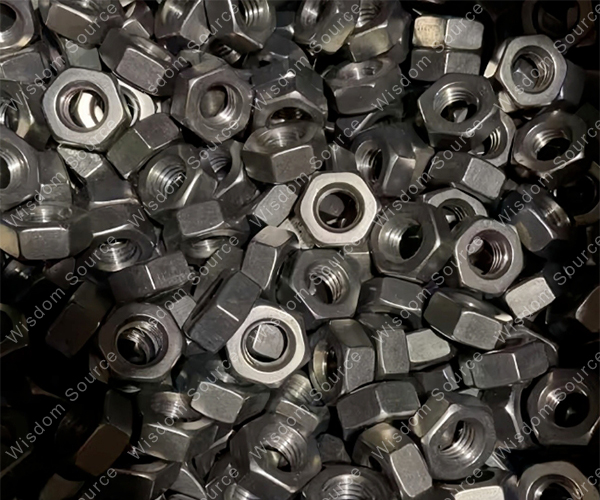
3. Pickling: The Key Control Of Surface Cleanliness
A mixture of hydrofluoric acid and nitric
acid is used for chemical cleaning to remove the oxide skin and surface
contaminants formed during thermal processing. After pickling, it is
supplemented by washing and neutralization treatment to ensure that the surface
is clean and subsequent molding defects are avoided.
4. Cold Heading/Warm Heading Forming: accurately shape the blank, use a mold to press the titanium wire into the bolt head and rod blank at room temperature or heating.
1) Cold heading: Suitable for β-type alloys with excellent plasticity at room temperature (such as
TB2, TB5, Ti-45Nb);
2) Temperature upsetting (650~800℃): For α+β alloys
such as TC4 to reduce deformation resistance and prevent cracking.
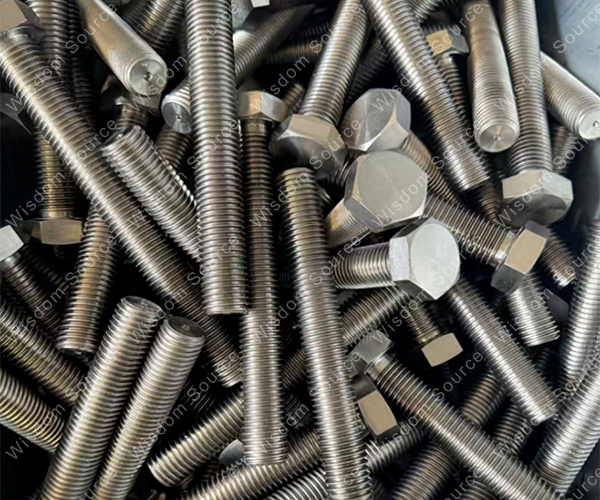
5. Thread Processing: process selection of rolling and cutting
1) Rolling thread: the thread strength is
improved by cold work hardening, which is suitable for mass production;
2) Cutting threads: used for large-size or
special-shaped bolts, with higher accuracy, but relatively low efficiency.
6. Heat Treatment: Quenching And Tempering, Enabling High Strength
The high-strength bolts must be tempered. The
typical process is solution + aging: first, the solution is dissolved at high
temperature, and then the aging at low temperature, the fine α phase is precipitated, and the strength is increased by more than
30%. After heat treatment, the hardness, tensile strength and flexural strength
ratio need to be strictly monitored to ensure compliance with grade 8.8 or 10.9
standards.
7. Surface Treatment: Anti-Corrosion, Anti-Friction And Functionalization
Common techniques include:
1) Anodizing: a dense oxide film is
generated, which has both anticorrosive and decorative functions, and can be
dyed;
2) Micro-arc oxidation: a ceramic coating of about 5µm is formed, which reduces the coefficient of friction from 0.8 to 0.15, and significantly improves the anti-bite performance;
3) Sandblasting/polishing: improve surface
finish, suitable for medical or high-end consumer goods.
8. Finished Product Inspection: All-round Quality Control
Comprehensive testing is the last line of
defense to ensure reliability, covering:
1) Chemical composition (spectral analysis);
2) Mechanical properties (tensile,
hardness, impact);
3) Non-destructive flaw detection
(ultrasonic detection of internal defects, eddy current detection of surface
cracks);
4) Size and appearance (benchmarking GB/T,
ISO, AMS and other international standards).
9. Application And Outlook
At present, titanium bolts have been widely used in C919 large aircraft (about 200,000 pieces per unit), deep-sea equipment and artificial joints and other fields. With the advancement of intelligent manufacturing and precision machining technology, its performance boundaries are still expanding, and it will show irreplaceable value in more extreme working conditions in the future.